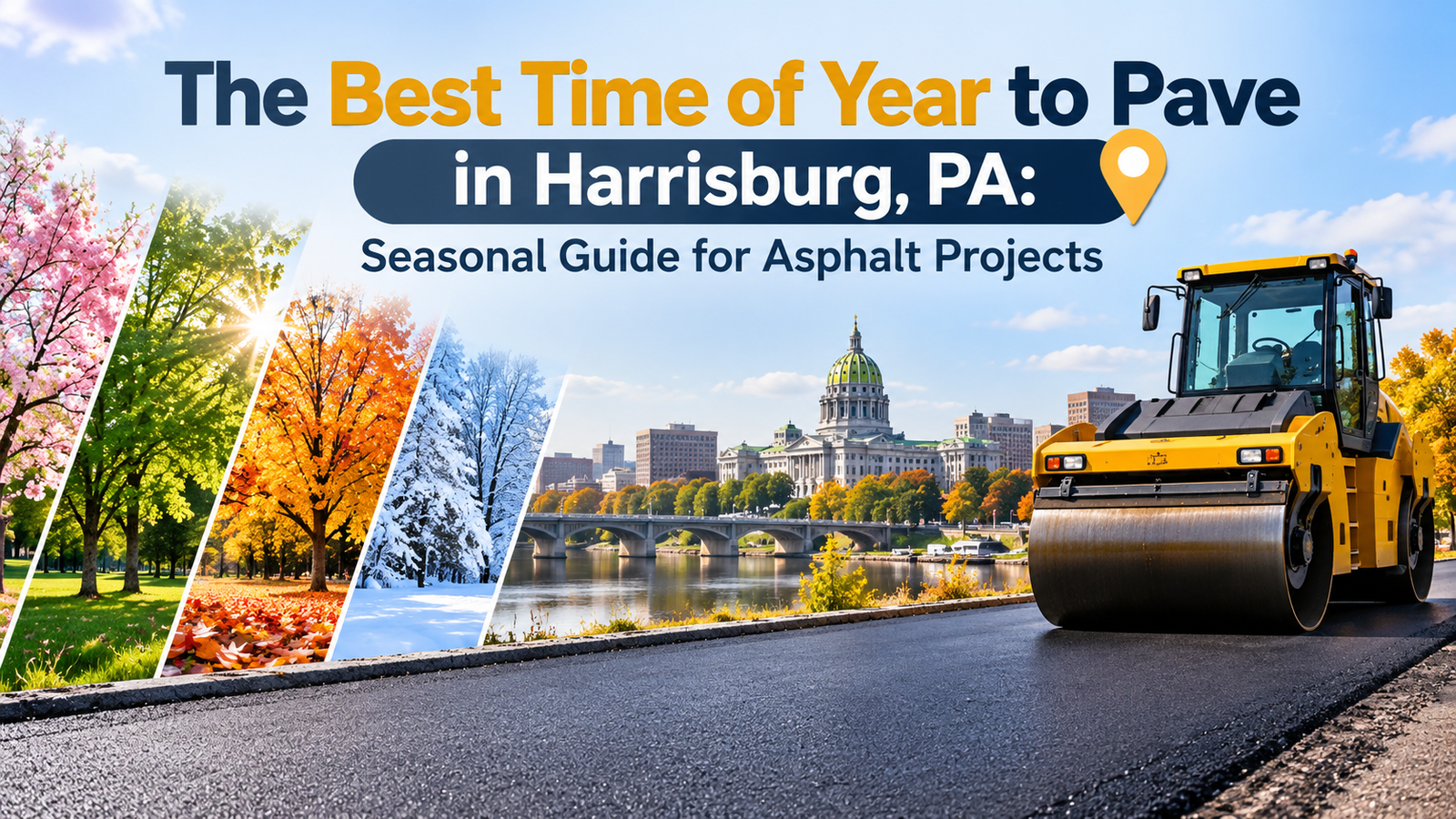

Harrisburg and the surrounding Dauphin County area experience a four-season climate that has a direct and significant effect on when asphalt paving can and should be done. Pennsylvania’s paving season is real and meaningful there are months when asphalt paving simply cannot be done well, months when it can but with more risk, and months when conditions are nearly ideal. Understanding the seasonal window for quality asphalt work in Central Pennsylvania helps property owners plan projects more effectively and set realistic expectations about scheduling.
Why Weather Conditions Matter for Asphalt Paving Quality
Asphalt is a thermally sensitive material. The mix leaves the plant at 280 to 320°F and must be placed and compacted while it is still hot enough for the aggregate particles to move under compaction pressure. Once the mat cools below approximately 175°F, the binder becomes too viscous for aggregate rearrangement, and compaction becomes ineffective. The window between placement and the point of uncompactable cooling is where all the critical work happens and that window is shorter in cold weather.
Cold ambient temperatures and cold base surfaces accelerate mat cooling. A mat placed at 280°F cools faster when the air temperature is 35°F than when it is 65°F; a mat placed on a cold, unheated base in the shade cools faster than one placed on a warm, sun-heated base. When the mat cools too quickly, the contractor cannot achieve the target density before the material locks up. Under-compacted asphalt has higher air void content than properly compacted asphalt, which means more permeable pavement that admits water and degrades faster.
Pennsylvania Department of Transportation (PennDOT) specifications establish minimum temperature requirements for asphalt placement: for surface course mixes, both the ambient temperature and the surface on which asphalt is being placed must be above 50°F. For base course mixes, the minimum is 40°F. Below these temperatures, surface and base course paving is generally not permitted under PennDOT specifications standards that most quality-conscious private paving contractors in Harrisburg follow as well, whether or not the project is technically governed by PennDOT.
Spring Paving in Harrisburg: Opportunity and Risk
Spring March through May in Harrisburg marks the reopening of the paving season after winter, and demand for paving projects spikes sharply as property owners address the damage that winter has inflicted. This is entirely understandable, but spring comes with specific risks that property owners should understand.
The biggest spring risk is subgrade condition. Pennsylvania soils are at their wettest and softest in the spring thaw period typically late February through April when frozen ground is melting, soil moisture is at its seasonal peak, and drainage systems are handling maximum flow. Pavement placed during this period, particularly on clay-bearing subgrades, is at higher risk of producing soft spots or base instability issues because the subgrade has less bearing capacity than it will have later in the dry season.
The practical guidance for spring paving in Harrisburg is to wait until soils have had best time of year to pave in harrisburg to dry out after thaw. In most years, late April through May offers significantly better subgrade conditions than March or early April. Projects on well-draining, granular subgrades can often proceed earlier in spring; projects on clay-bearing sites benefit from waiting for the soil to firm up.
Spring weather in Harrisburg is also variable and wet average rainfall in April and May is among the highest of the year. Rain events that occur while paving is in progress are problematic: water on the base before paving weakens the subgrade, and rain falling on freshly placed asphalt cools the mat rapidly and can compromise compaction in progress. Monitoring the forecast closely and scheduling paving operations around rain events is standard practice.
Summer Paving: The Optimal Season
June through August is the heart of Harrisburg’s paving season and generally the best period for asphalt work in Central Pennsylvania. Temperatures are reliably above minimums for paving, mat cooling is slower (giving compaction crews more time), and precipitation events are manageable with good scheduling. The long daylight hours of summer allow larger projects to be completed in a single day.
The primary management consideration for summer paving in Harrisburg is heat. Pavement surface temperatures in July and August can reach 140 to 160°F on sunny days. Freshly placed asphalt on a very hot surface may take longer to set up sufficiently for traffic reopening. Newly paved surfaces in the heat of summer remain softer for longer, and concentrated vehicle loads tires, kickstands, dumpster placements can mark the surface more easily in the first weeks after placement than in cooler weather.
Summer scheduling for commercial and retail properties requires coordinating paving with the property’s operating needs. Paving during early morning hours or on weekends minimizes disruption to businesses; closing sections of a parking lot in phases allows the property to remain at least partially operational throughout the project.
Fall Paving: Excellent Conditions with a Closing Window
September and October are ideal months for asphalt paving in Harrisburg. Temperatures are moderate, rainfall is typically below the spring peak, soils have dried out from summer, and the combination of conditions produces excellent paving quality. The asphalt industry in Central Pennsylvania often considers September and October the best paving months of the year demand is high, conditions are reliable, and quality is consistently good.
The window closes in November. As temperatures drop toward the 50°F threshold which in Harrisburg typically occurs in mid to late October on a daily basis, though warm spells can extend into early November the risk of producing under-compacted pavement increases. Surface course paving in Harrisburg is generally concluded by early November in most years. Base course work can continue somewhat later because of the lower minimum temperature requirement.
Sealcoating, crack sealing, and other maintenance treatments that use water-based or emulsion products have an even earlier cutoff in fall. These treatments must be applied above 50°F and must cure before temperatures drop to freezing. In Harrisburg, the practical cutoff for sealcoating is typically mid-October, and for crack sealing with hot-pour sealant, slightly later because hot-pour sealant cures independently of temperature.
Winter: Why Paving Stops in Pennsylvania
Asphalt paving in Harrisburg essentially stops from December through February in most years, resuming only during extended warm spells when temperatures consistently exceed 50°F. The reasons are technical: cold air and cold pavement surface temperatures cause mat cooling that is too fast for proper compaction, resulting in under-compacted, air-void-rich pavement that will deteriorate significantly faster than properly compacted material.
Beyond the compaction issue, placing asphalt on a frozen base is problematic. The base may appear solid but is in a temporarily stiffened state from frost; when it thaws in spring, differential settlement can occur that deforms the new pavement placed on top of it. Placing asphalt on a base that contains ice or frost is specifically prohibited under PennDOT specifications.
Cold-mix asphalt emulsified or cut-back asphalt mixes that remain workable at lower temperatures is sometimes used for emergency pothole repairs and patching during winter. Cold mix is not a permanent paving material; it is a temporary fix that holds a repair until conditions allow permanent hot-mix replacement. Property managers who need to address winter pavement damage in Harrisburg can use cold mix to keep surfaces functional until spring, then schedule permanent repairs when the paving season reopens.
Planning Your Harrisburg Paving Project Around the Season
Property owners planning paving projects in the Harrisburg area should account for the seasonal demand cycle when scheduling. Spring and fall are peak scheduling periods contractors’ books fill quickly after winter ends and again in August as property owners try to get work done before the season closes. Planning ahead, engaging a contractor in late winter or early summer for fall work, or in early fall for the following spring, provides more scheduling flexibility and may produce better project coordination.
Frequently Asked Questions: Best Time to Pave in Harrisburg
What temperature is too cold to pave asphalt in Harrisburg?
PennDOT specifications the standard followed by quality contractors throughout Central Pennsylvania require that both the ambient temperature and the surface temperature be above 50°F for surface course placement, and above 40°F for base course placement. Below these temperatures, the asphalt mat cools too quickly for proper compaction, resulting in under-compacted pavement with higher air void content that admits water and deteriorates faster. In practice, Harrisburg’s paving season runs from approximately April through early November.
Is fall paving as good as spring paving in Harrisburg?
Fall September and October specifically is often considered the best paving season in Central Pennsylvania. Soils have dried from summer, temperatures are moderate and stable, precipitation is typically lighter than spring, and the combination of conditions produces excellent paving quality. The limitation is the closing window: surface course paving should be completed before mid to late October to ensure conditions above the 50°F minimum before the season closes.
Can paving be done in Harrisburg in the winter?
Routine hot-mix asphalt paving is not practical in Harrisburg from December through February. Cold temperatures cause mat cooling that is too fast for proper compaction, and placing asphalt on frozen base is not permitted under standard specifications. Cold-mix asphalt can be used for emergency patching during winter as a temporary fix, with permanent hot-mix repairs scheduled for spring. The paving season typically resumes in late March to April depending on spring temperatures.
Why should sealcoating be done before fall in Harrisburg?
Sealcoating is a water-based or emulsion product that requires temperatures above 50°F to cure properly, and it must cure completely before the first freeze. In Harrisburg, the practical cutoff for sealcoating is mid-October. Sealcoat applied too close to freezing temperatures may not cure fully and will peel, crack, or wash away during the first frost. The optimal window for fall sealcoating in Harrisburg is August through early October, when cure time before winter cold is assured.